
The origin of German Chocolate Cake is one of my favorite cautionary tales for culinary students. I still remember the first time I served German Chocolate Cake to a table of European guests while cooking on the Virginia Beach waterfront. One gentleman from Stuttgart took a bite, raised an eyebrow, and whispered, “This is not from my country.” He was right, of course, yet most Americans—my younger self included—grew up believing the dessert was an Old-World classic. In truth, the cake is as Texan as bluebonnets, and its name is the result of nothing more historic than a dropped apostrophe and a marketing windfall. These days, here in my Albany, Missouri teaching kitchen—housed in a restored 1890s livery stable—I demonstrate the recipe whenever I want to illustrate how a single newspaper column can rewrite culinary history.
1852: The Chocolate That Started It All
The story begins not in Europe, but in Dorchester, Massachusetts, with an English-American baker named Samuel German. In 1852 he developed a dark baking chocolate that contained far more sugar than existing unsweetened bricks. Walter Baker (founder of Baker’s Chocolate Company) purchased the formula for one thousand dollars and christened the product “Baker’s German’s Sweet Chocolate”—note the possessive ’s that would later vanish.
For almost a century the chocolate was used sparingly—mostly in puddings and frostings—until a Texas housewife married it to two ingredients abundant in the South: shredded coconut and pecans.
June 3, 1957: The Recipe That Went Viral—Before the Internet
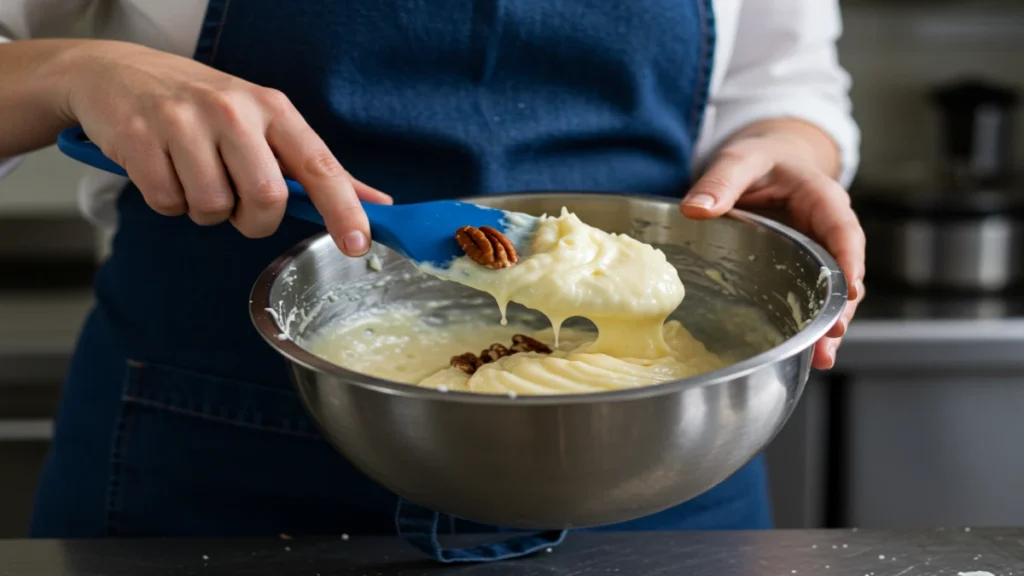
Mrs. George Clay of Dallas submitted her “German’s Chocolate Cake” to The Dallas Morning News “Recipe-of-the-Day” column. Within weeks, General Foods (then owner of Baker’s) reprinted the recipe nationwide. Sales of German’s Sweet Chocolate jumped 73 percent in a single year, and by 1963 the cake was on the White House luncheon menu for German Chancellor Ludwig Erhard—who, ironically, may have wondered why he had never tasted it at home.
In the frenzy of republication, the possessive ’s quietly disappeared. “German’s” became “German”, and a linguistic sleight-of-hand rewrote culinary folklore.
Mid-Century America on a Plate
Why did the cake capture the nation’s imagination? The 1950s were a golden age of home baking: new leaveners, affordable stand mixers, and post-war prosperity placed layer cakes at the center of bridge clubs and church picnics. German Chocolate Cake delivered drama—three lofty tiers, a mahogany crumb, and a lava-like filling of custard, coconut, and toasted pecans—without demanding European technique.
The flavor profile also rode the wave of Southern pantry staples. Pecan pies, Lane cakes, and coconut confections had primed palates for the combination. When I teach the cake in my Santa Clara pop-ups (yes, I still return for guest classes), I reference my go-to buttermilk biscuit ratio—the same tangy dairy that tenderizes this crumb.

Anatomy of the Original Formula of the Origin of German Chocolate Cake
Mrs. Clay’s 1957 recipe still appears on the back of Baker’s German Sweet Chocolate boxes. Here are the hallmarks I insist on when recreating it:
- Sweet baking chocolate (48 % sugar) for a mellow cocoa note.
- Buttermilk for gentle tang and a tender crumb.
- Egg-yolk enriched custard cooked to 82 °C (180 °F) to coat the pecans and coconut without curdling.
- No outer frosting—only the coconut-pecan filling cloaks the top and sides, allowing the cake’s chocolate flavor to remain in balance.
Modern adaptations often blanket the sides with chocolate buttercream for cleaner slices, but I side with pastry historian Stella Parks: “It’s inappropriate to have chocolate frosting. The cake has enough cocoa; the filling is the star.”
Separating Myth from Menu
If you order Schwarzwälder Kirschtorte in Munich, you’ll receive layers of kirsch-laced chocolate sponge, sour cherries, and whipped cream—an entirely different dessert. German Chocolate Cake has no Teutonic cousin; it is as singular to American baking as the Boston cream pie. When I demonstrate the cake for visitors here in Albany, I always pair it with my Virginia Beach sea-salted caramel drizzle; the briny edge reminds me of the ocean breezes that once rattled my coastal kitchen windows.
FAQ about the origin of German Chocolate Cake
Q: Can I substitute semi-sweet chocolate for German’s Sweet Chocolate?
A: You may, but reduce added sugar by 25 g (2 Tbsp) per 115 g (4 oz) chocolate to avoid cloying sweetness.
Q: Why did the apostrophe disappear?
A: Typesetters and hurried food editors simply left it out; the public assumed the name referred to the country, and the error stuck.
Q: Is National German Chocolate Cake Day really June 11?
A: Yes—an entirely American holiday celebrating an entirely American cake.
A Final Note from My Albany Kitchen
The next time you slice into a German Chocolate Cake, remember you are tasting mid-century optimism: a nation’s sweet tooth, a company’s marketing savvy, and a Dallas housewife’s reliable oven. It may not be authentically German, but it is undeniably authentic to the American table.
If you bake the original, send me a photograph by posting on my facebook group where i post my daily decious recipes —I still keep Mrs. Clay’s clipping taped inside my recipe journal, apostrophe and all.